
“Silent” and “Low Friction”: Why Bearings in 2026 Are Quietly Changing the World
In factories, electric vehicles, robots, warehouses, wind turbines, and even smart home appliances, something unusual is happening in 2026:
Machines are getting quieter.
Not just “less noisy” — quieter in a way people actually notice.
Electric cars no longer roar. Warehouse robots glide across floors with a soft hum. Industrial machines that once sounded like metal monsters now operate with almost eerie smoothness. Even household appliances are being marketed with phrases like ultra-quiet drive system and silent operation technology.
And behind much of this silence is one surprisingly small component:
The bearing.
For decades, bearings were judged mainly by durability and load capacity. If they rotated smoothly and lasted long enough, they did their job. But in 2026, the conversation has changed dramatically.
Now the industry is obsessed with two keywords:
- Silent
- Low Friction
These are no longer “premium features.” They are becoming essential requirements across automotive, robotics, automation, renewable energy, and smart manufacturing.
So why is the world suddenly demanding quieter, lower-friction bearings?
And why are engineers spending millions trying to remove noises most people can barely hear?
Let’s explore the fascinating shift happening inside modern machinery.
The Strange Truth About Noise: Humans Hate Friction More Than Ever
Twenty years ago, loud machines were considered normal.
A truck sounded like a truck.
A factory sounded like a factory.
A power tool screamed like it wanted revenge.
But modern consumers and industries have changed.
Today, silence feels advanced.
Think about it:
- A quiet EV feels more luxurious.
- A silent robot feels more intelligent.
- A smooth-running machine feels more reliable.
- A low-noise warehouse feels safer and more organized.
Noise is now associated with:
- energy loss
- inefficiency
- vibration
- wear
- poor engineering
In many industries, reducing sound is no longer just about comfort. It directly affects:
- energy consumption
- product lifespan
- worker fatigue
- customer satisfaction
- precision performance
And this is where bearings become incredibly important.
Because in rotating systems, friction and vibration are often born inside the bearing itself.
Why Bearings Became the “Invisible Noise Source”
Most people only notice a bearing when it fails.
But engineers know bearings are often the hidden source of:
- vibration
- heat
- resistance
- mechanical noise
Even microscopic imperfections inside a bearing can create:
- high-frequency sounds
- energy loss
- unstable rotation
- resonance through the entire machine
In 2026, machines are becoming:
- faster
- lighter
- more compact
- more precise
That means bearings now operate under much harsher expectations.
For example:
An EV motor may spin above 20,000 RPM.
A warehouse sorting robot may run 24 hours a day.
A collaborative robot arm may need millimeter-level precision.
Under these conditions, even tiny friction becomes a serious problem.
The bearing industry is no longer just about “rotation.”
It is about:
- silence engineering
- thermal control
- vibration management
- energy efficiency
Why Electric Vehicles Changed Everything
If one industry accelerated silent bearing technology faster than anything else, it was the EV industry.
Traditional gasoline vehicles naturally masked mechanical sounds because engines were loud.
Electric vehicles removed that cover.
Suddenly, drivers could hear everything.
Small bearing noises that were once invisible became obvious:
- high-pitched whining
- vibration hum
- rotational resonance
Consumers paying premium prices for EVs expected a smooth, futuristic experience — not strange mechanical sounds.
As a result, automakers began demanding:
- ultra-low-noise bearings
- low-friction materials
- precision lubrication systems
- tighter manufacturing tolerances
This forced bearing manufacturers into a technological race.
Some companies now test bearings in near-silent acoustic chambers because sounds humans barely notice can still affect perceived vehicle quality.
Ironically, the quieter machines become, the more noticeable tiny imperfections become.
The Science of “Low Friction”
Friction sounds simple.
But in engineering, friction is expensive.
Every bit of friction creates:
- heat
- wear
- power loss
- noise
- reduced efficiency
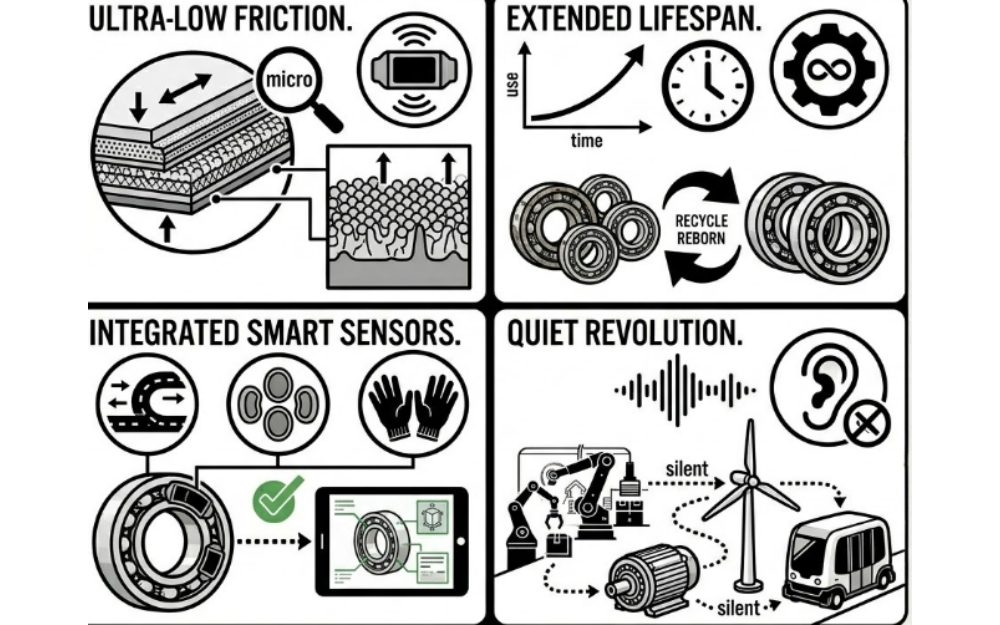
In 2026, low-friction bearing design has become a major competitive advantage.
Why?
Because lower friction means:
- lower electricity consumption
- higher rotational speed
- less lubrication demand
- reduced maintenance
- longer service life
Even a tiny reduction in friction can save enormous energy in large industrial systems.
For example:
A logistics warehouse operating thousands of conveyor rollers can reduce power costs significantly by using low-friction bearings.
A wind turbine using optimized bearings can improve long-term efficiency over years of operation.
An EV with lower drivetrain resistance may gain additional driving range.
Suddenly, friction is not just a physics problem.
It is a business strategy.
Bearings Are Entering the Age of Surface Engineering
One of the most exciting changes in 2026 is that bearings are no longer “just steel balls.”
Modern bearings now involve advanced material science.
Manufacturers are experimenting with:
- ceramic hybrid bearings
- nano-coatings
- graphene-based lubrication concepts
- ultra-polished raceways
- self-lubricating surfaces
The goal?
Reduce microscopic resistance.
Some bearing surfaces are polished so precisely that imperfections become nearly invisible even under magnification.
Others use advanced coatings to reduce metal-to-metal contact.
This creates:
- smoother motion
- quieter operation
- lower heat generation
In some industries, engineers now measure friction improvements so tiny they sound almost ridiculous.
But when multiplied across millions of rotations per day, those tiny gains become huge.
Why Robots Need “Whisper-Level” Bearings
Robots are another major reason silent bearings exploded in popularity.
Industrial robots once operated behind safety fences where noise did not matter much.
But modern collaborative robots — “cobots” — now work beside humans.
And humans dislike noisy machines nearby.
Imagine a robot arm making clicking or grinding sounds beside you all day in:
- hospitals
- warehouses
- electronics factories
- restaurants
- retail stores
It immediately feels less intelligent and less trustworthy.
As robots become more human-centered, silence becomes part of the user experience.
Engineers now describe some robot bearing systems using phrases like:
- whisper motion
- smooth tactile response
- acoustic comfort
This would have sounded absurd in traditional heavy industry twenty years ago.
Now it is a serious engineering category.
Quiet Machines Are Also Safer
An interesting trend in 2026 is that low-noise systems can actually improve workplace safety.
At first this sounds strange.
Wouldn’t louder machines help people notice danger?
Not necessarily.
In noisy industrial environments:
- alarms are harder to hear
- workers experience fatigue faster
- communication becomes difficult
- stress levels increase
Lower-noise machinery helps create:
- clearer communication
- reduced mental fatigue
- improved concentration
- more comfortable work environments
This is especially important in automated warehouses and smart factories where humans and machines work together continuously.
Ironically, reducing bearing noise may help people notice important sounds more easily.
The Lubrication Revolution Nobody Talks About
Bearings themselves are not the only thing evolving.
Lubrication technology in 2026 is becoming incredibly advanced.
Modern lubricants are being designed specifically for:
- low torque
- silent operation
- thermal stability
- high-speed rotation
Some smart lubrication systems even monitor:
- temperature
- vibration
- rotational speed
And automatically adjust lubrication performance.
In other words:
The bearing industry is slowly becoming a software-assisted industry.
Not just a mechanical one.
Consumers Now Expect “Invisible Engineering”
One fascinating change in modern manufacturing is this:
The better engineering becomes, the less people notice it.
Nobody buys an appliance because the bearing is excellent.
But they absolutely notice:
- annoying sounds
- vibration
- rough motion
- overheating
- energy waste
Consumers increasingly expect machines to feel:
- smooth
- silent
- effortless
And achieving that feeling often depends heavily on bearing quality.
The bearing has become one of the most important invisible technologies in modern life.
Sustainability Is Pushing Low-Friction Technology Even Further
In 2026, sustainability goals are influencing almost every industrial decision.
Lower-friction bearings help companies:
- reduce electricity usage
- lower carbon emissions
- extend equipment lifespan
- minimize waste
This matters because global industries are under pressure to improve energy efficiency.
Even small improvements matter at scale.
For example:
- lower friction means less heat
- less heat means less cooling demand
- less cooling means lower energy consumption
The chain reaction becomes economically valuable.
That is why bearing manufacturers are now marketing efficiency almost as aggressively as durability.
The Future: Bearings That “Disappear”
Perhaps the ultimate goal of modern bearing technology is this:
To become invisible.
Not physically invisible — experientially invisible.
The perfect bearing is one nobody notices because:
- it makes no noise
- creates minimal resistance
- requires little maintenance
- operates smoothly for years
In the future, bearings may become:
- sensor-integrated
- AI-monitored
- self-lubricating
- predictive-maintenance enabled
But the mission remains surprisingly simple:
Make machines feel effortless.
Final Thoughts
For decades, bearings were viewed as ordinary industrial components.
But in 2026, they are quietly becoming one of the most important technologies behind:
- electric vehicles
- robotics
- automation
- renewable energy
- smart manufacturing
And the industry’s biggest obsession is no longer just strength.
It is refinement.
“Silent” and “low friction” are not marketing buzzwords anymore.
They represent a major shift in how machines are designed, experienced, and optimized.
The future of machinery may not be louder, bigger, or more aggressive.
It may simply be smoother, quieter, and smarter.
 “Silent” and “Low Friction”: Why Bearings in 2026 Are Quietly Changing the World
 Bearings vs. Humans: Who Handles Stress Better?
 Why are high-end equipment manufacturers starting to redefine bearings?
 Croatia's agricultural machinery demand for these three types of bearings